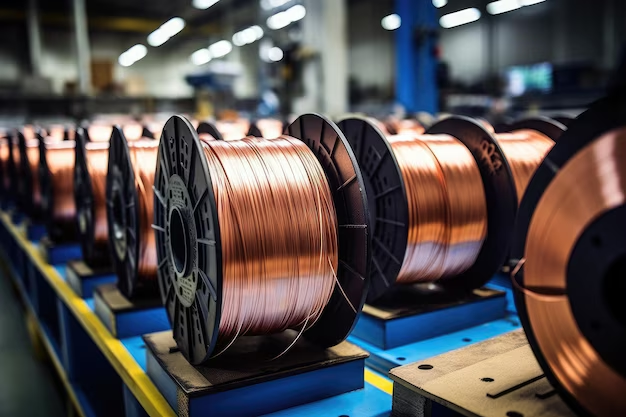


(A Complete Beginner-Friendly 2025 Guide)
Electric Vehicles (EVs) are becoming a normal part of daily life. Whether it’s a car like the Tata Nexon EV, MG ZS EV, Mahindra XUV400, or even electric scooters like Ather, Ola, and TVS—millions of people in India are now switching to electric mobility.
And with this shift, home EV charging has become one of the most important topics for every new EV owner.
But one question almost everyone asks is:
“Which cable do I need to safely charge an EV at home?”
This blog will explain everything in simple language—no technical confusion, no hard engineering terms.
Just a clean, easy-to-read guide full of examples, tables, and practical advice.
Let’s begin.
🟦 1. Why Home EV Charging Matters in 2025
Charging your EV at home is:
- Cheaper
- Safer
- More convenient
- Healthier for the battery
Most EV owners charge 80–90% of their total monthly charging at home, which makes the cable quality extremely important.
A wrong or low-quality cable can cause:
- Slow charging
- Overheating
- Battery damage
- Electrical fire
- Tripping of the MCB
- Shock or short-circuit
So choosing the right cable is not “optional”—it is essential.
🟦 2. Types of EV Home Charging
There are three main types of home EV charging:
| Charging Type | Voltage | Charging Speed | Typical Use |
|---|---|---|---|
| Level 1 (Standard 230V Socket Charging) | 230V AC | Slow | Scooters, small EVs, overnight charging |
| Level 2 (Dedicated AC Wall Charger) | 230V–415V AC | Medium to Fast | Most electric cars in India |
| Level 3 (DC Fast Charging) | Not for homes | Very Fast | Public stations only |
In India, Level 1 and Level 2 EV charging are used at home.
Now let’s understand what cable you need for each type.
🟦 3. Which Cable Is Used for Home EV Charging?
There are two types of cables involved:
A) The Charging Cable That Connects EV → Charger
This is usually provided by the EV company.
Types include:
- Type-1 cable
- Type-2 cable (most common in India)
- Portable charger cable (for 5A/15A sockets)
This cable rarely needs replacement unless damaged.
B) The Electrical Cable That Connects House Wiring → EV Charger (Most Important)
This is the cable inside your home, carrying electricity from the mains to your EV charger.
This is the cable KE Kable specializes in, and this is the one we must choose carefully.
🟦 4. How to Select the Right Home EV Charging Cable (Step-by-Step)
Choosing the correct cable depends on:
- Your EV’s charging capacity
- Whether you will install a home wall charger
- Distance from meter board to parking location
- Load capacity of your home
- Future EV plans
Let’s break it down.
🟥 5. Cable Thickness (Gauge) Required for EV Charging
Your EV charger will pull between 10A to 32A typically.
So the cable must handle that current safely without overheating.
✔ Recommended Cable Sizes for Home EV Charging
| Charger Type | Ampere Load | Recommended Cable Size | KE Kable Product Suggestion |
|---|---|---|---|
| Regular 15A Portable Charger | 10–15A | 2.5 sq mm Copper Cable | KE Power Cable 2.5mm – (/product/power-cables) |
| Wall Charger 3.3 kW | 15–16A | 4 sq mm Copper Cable | KE Heavy-Duty 4mm Cable – (/product/core-cables) |
| Wall Charger 7.2 kW | 30–32A | 6 sq mm Copper Cable | KE High-Performance 6mm Cable – (/product/electrical-wires) |
| Future-proof Installation | 32A+ | 10 sq mm Copper Cable | KE Ultra-Safe 10mm Cable – (/product/power-cards) |
✔ All values based on standard IS-694 / IEC wiring practices.
✔ Copper cables are always preferred for EV charging due to better conductivity.
🟦 6. Why Copper Cables Are a Must for EV Charging
Many people ask:
“Can we use aluminum cables for EV charging?”
NO.
Aluminum cables heat more, carry less current safely, and are not suitable for continuous heavy load.
Copper cables offer:
- Higher conductivity
- Lower heat generation
- Longer life
- Safer charging
- Less voltage drop
- Better performance in long-distance wiring
KE Kable manufactures high-quality copper cables designed exactly for this purpose.
🟦 7. How Cable Length Affects Charging Safety
If your parking area is far from your meter board, a thinner cable will cause voltage drop.
This results in:
- Slower charging
- More heat inside the wire
- Reduced EV battery health
Here is a simplified table:
| Distance Between Meter & Charging Point | Recommended Cable Size |
|---|---|
| Up to 10 meters | 4 sq mm |
| 10 to 25 meters | 6 sq mm |
| 25 to 40 meters | 10 sq mm |
| 40+ meters | 10 sq mm + double-layer conduit |
If distance is high, choose a size one level thicker.
🟦 8. Should You Install a Dedicated MCB / RCCB?
YES. 100% yes.
A dedicated circuit is mandatory for safe EV charging.
Recommended Setup:
- 32A MCB (for wall chargers)
- 30mA RCCB or RCBO
- 6 sq mm / 10 sq mm copper cable
- Conduit protection (PVC or HDPE)
This prevents:
- Fire
- Short circuit
- Overload
- Electric shock
KE Kable strongly suggests using high-quality, certified wires for such circuits.
🟦 9. Cable Material Comparison (Simple Table)
| Feature | Copper Cable | Aluminum Cable |
|---|---|---|
| Conductivity | High | Medium |
| Heat Resistance | Excellent | Poor |
| Lifespan | Long | Medium |
| Suitable for EV Charging? | ✔ Yes | ❌ No |
| Safety | High | Medium |
| Efficiency | High | Low |
Clear winner: Copper.
🟦 10. Single Core vs Multi-Core: Which Is Better?
✔ Single-Core Copper Cable (Recommended)
Best for fixed EV charger installation.
Advantages:
- Less heat
- Higher current capacity
- Best for long distances
- Most safe option
✔ Multi-Core Cable (Optional)
Useful for portable or flexible routing.
KE Kable offers both:
- Single core wires → (/product/core-cables)
- Multi-core wires → (/product/electrical-wires)
🟦 11. Which Cable Insulation Type Is Best?
You should choose:
✔ FR (Flame Retardant)
OR
✔ FR-LSH (Low Smoke & Halogen)
For EV charging, FR-LSH is the safest.
Benefits:
- Less smoke during fire
- No toxic gases
- Higher heat resistance
KE Kable FR-LSH wires → (/product/electrical-wires)
🟦 12. Why Cheap Cables Are Dangerous for EV Charging
Cheap or fake wires can:
- Melt
- Catch fire
- Damage your charger
- Destroy your EV battery
- Trigger house wiring failure
Indicators of fake cables:
- Too lightweight
- Very low price
- No ISI mark
- No copper shine
- Very soft insulation
- No brand details
Always use BIS-certified, branded cables like KE Kable for EV charging.
🟦 13. How to Install EV Charging Cable Safely (Simple Steps)
- Check the EV charger rating (kW).
- Calculate the distance from meter to parking.
- Choose the correct cable size.
- Use high-quality copper wire.
- Install a dedicated MCB.
- Install RCCB for protection.
- Use conduits to protect wires.
- Test the charger before regular use.
KE Kable wires support long-term heavy load AND maintain safety.
🟦 14. Real-Life Cable Selection Examples
Example 1 – Small Car + Close Parking
- Tata Tiago EV
- 3.3 kW charger
- Distance: 8m
✔ Cable needed: 4 sq mm Copper
✔ Product link: (/product/core-cables)
Example 2 – SUV + Medium Distance
- MG ZS EV
- 7.2 kW charger
- Distance: 20m
✔ Cable needed: 6 sq mm Copper
✔ Product link: (/product/power-cables)
Example 3 – Future-Proof EV Setup
- Planning another EV soon
- 7.2 kW system
- Distance: 25–35m
✔ Cable needed: 10 sq mm Copper
✔ Product link: (/product/electrical-wires)
🟦 15. Do You Need Braided Cables?
Not for the main house wiring.
But for:
- Portable EV chargers
- EV accessories
- Durable outdoor usage
Braided cables offer extra toughness.
KE Kable offers braided wire solutions → (/product/braided-wires)
🟦 16. Can You Use Extension Boards for EV Charging?
Absolutely not.
This is dangerous.
Reasons:
- Extension boards are not designed for high load
- They can melt
- Risk of fire
- Slow charging
- Damages the charger
Always use direct wall socket or dedicated EV charger.
🟦 17. How Weather Affects the Cable You Choose
If your parking is open or semi-open:
Use:
- Waterproof conduit
- FR-LSH cable
- UV-resistant insulation
KE Kable cables are tested for high heat, moisture & environmental protection.
🟦 18. EV Cable Safety Checklist (Printable)
| Safety Rule | Status |
|---|---|
| Use copper wire | ✔ / ✘ |
| Correct cable size | ✔ / ✘ |
| Dedicated MCB | ✔ / ✘ |
| RCCB installed | ✔ / ✘ |
| Waterproof conduit | ✔ / ✘ |
| No extension boards | ✔ / ✘ |
| Regular inspection | ✔ / ✘ |
🟦 19. Common EV Charging Myths (Debunked)
❌ Myth 1: Any wire can charge an EV
✔ Nope. EVs require high-load copper wires.
❌ Myth 2: Thick wires waste electricity
✔ Thicker wires actually save electricity by reducing heat & loss.
❌ Myth 3: Portable chargers don’t need special wiring
✔ They need correct wiring more than anything!
❌ Myth 4: Aluminum wire works fine
✔ Never for EV charging.
🟦 20. KE Kable Product Recommendations for EV Charging
Here are the best KE Kable products:
| Use Case | Recommended KE Kable Product |
|---|---|
| Home EV Wall Charger | 4–10 sq mm FR-LSH Copper Cable |
| Outdoor Charging Lines | Heavy-Duty Power Cable |
| Portable Charger Support | Braided Flexible Wire |
| Industrial EV Charging Setup | High Gauge Single Core Cables |
🟦 21. Final Recommendation — What Cable Should YOU Choose?
Here’s the simple final answer:
✔ If using portable charger → 4 sq mm
✔ If installing 3.3 kW wall charger → 4 sq mm
✔ If installing 7.2 kW charger → 6 sq mm
✔ If distance is 25m+ → 10 sq mm
And ALWAYS use:
- Copper
- FR-LSH
- Branded certified wires
- Dedicated MCB + RCCB
🟩 22. Conclusion
Home EV charging is convenient, safe, and cost-effective—but only if the wiring is done correctly.
✔ A good cable = Safe charging
✔ A good cable = Long battery life
✔ A good cable = Lower electricity loss
✔ A good cable = Fire safety
Choosing a high-quality, certified copper cable from a trusted manufacturer like KE Kable is the best investment for any EV owner.
If you’re planning to install or upgrade your home EV charger, explore KE Kable’s complete range here: