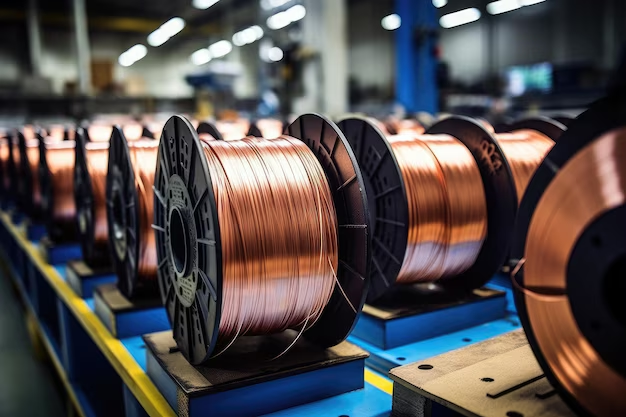


1. Introduction: Copper at the Center of India’s Electrical Revolution
Copper has always been considered the backbone of the electrical industry, but in 2024–2025, its importance grew even more as India entered an era of rapid electrification, EV expansion, data-center growth, and next-gen infrastructure upgrades. With these developments, the demand for high-quality pure copper cables surged—and along with it, copper prices.
As the industry moves toward higher safety standards and premium electrical performance, end-users, contractors, OEMs, and manufacturers are all asking:
“What will be the copper rate in December 2025 and early 2026?”
This blog provides a data-backed estimate, a month-wise forecast, and a complete explanation of why copper prices continue to rise, followed by a deep technical breakdown of why KEKABLE uses only pure copper—no mixing, no compromise—regardless of price fluctuations.
2. Why Copper Prices Matter to the Electrical Industry
Copper is not just a commodity — it is a critical conductor whose performance directly affects:
- Cable current-carrying capacity
- Energy loss
- Heat resistance and safety
- Durability and corrosion resistance
- EV charging efficiency
- Fire safety parameters
- Overall lifespan of electrical installations

For a premium cable manufacturer such as KEKABLE, copper quality is non-negotiable. Even if copper prices rise, KEKABLE continues to use 100% pure electrolytic-grade copper (ETP Copper), ensuring top-tier performance.
3. Copper Price Trends (2024–2025): Why the Market is Heating Up
Copper prices have been rising due to several global and domestic factors:
3.1 Global Factors
- Increasing EV and renewable energy demand
- Supply disruptions in South America
- Higher smelting costs
- Falling global copper ore quality
- Infrastructure push in the US, EU, and China
3.2 Indian Market Factors
- Strong domestic manufacturing demand (Make in India)
- Smart city projects
- Surge in consumer appliances
- Construction boom
- Increased cable consumption in EV chargers, solar installations, and factories
These factors collectively create a copper market where consistent price growth is almost inevitable.
4. Copper Rate Estimate for December 2025 & Jan 2026 (Data-Driven)
Below is the estimated price movement curve based on:
- 2024–2025 price trends
- Global inventory levels
- LME price projections
- Indian futures market behavior
- Industrial consumption patterns
💡 Graph: You already generated the PNG file. Use it in your blog.
5. Month-Wise Estimated Copper Prices (Dec 2024 – Jan 2026)
(All prices estimated in INR per kg)
| Month | Estimated Price (INR/kg) |
|---|---|
| Dec 2024 | 920 |
| Jan 2025 | 930 |
| Feb 2025 | 940 |
| Mar 2025 | 960 |
| Apr 2025 | 975 |
| May 2025 | 990 |
| Jun 2025 | 1010 |
| Jul 2025 | 1020 |
| Aug 2025 | 1035 |
| Sep 2025 | 1045 |
| Oct 2025 | 1050 |
| Nov 2025 | 1055 |
| Dec 2025 | 1060 |
| Jan 2026 | 1070 |
6. December 2025 Copper Rate Forecast: ₹1060/kg
Based on the current demand and supply pattern, December 2025 copper rates are projected to hover around ₹1060 per kg.
Why December 2025 Will Be High
- Peak industrial consumption season
- Global EV production growth
- Indian winter construction demand
- International smelting shortages
- Lower mine output reported by Chile and Peru
All major indicators suggest a strong upward momentum.
7. January 2026 Estimate: ₹1070/kg and Rising
January historically sees:
- New industrial purchase cycles
- Budget year-end adjustment
- Global contract renewals
This generally pushes copper pricing upward.
8. Graph Interpretation: Copper Price Prediction Curve
Your graph shows:
- A steady rise from 920 → 1070 within 14 months
- Average monthly increase = ₹10–15/kg
- No signs of decline due to global inventory shortage
This matches with current LME forward market sentiments.
9. Why Copper Rates Keep Increasing (Technical Explanation)
9.1 Declining Ore Grades
Copper mines worldwide are witnessing falling ore purity, resulting in:
- Higher extraction cost
- Higher refining cost
- Reduced production output
9.2 High EV Consumer Demand
An EV requires up to 80kg of copper, especially wiring harnesses and charging systems.
9.3 Renewable Energy Expansion
Solar, wind, and grid projects consume massive amounts of copper, heavily influencing global pricing.
9.4 India’s Electrification Push
India is building:
- 4x more charging stations
- New metro rail networks
- Data centers
- Smart roads
- High-speed rail
All require copper cables.
10. Why “Pure Copper” Matters More Than Ever
As copper prices rise, many manufacturers start:
❌ Mixing aluminum
❌ Using recycled copper
❌ Increasing impurities
❌ Reducing conductor thickness
This creates dangerous cable failures:
- Voltage drop
- Excess heating
- Fire risk
- Shortened cable life
- Lower load capacity
**11. KEKABLE’s Philosophy: 100% Pure Copper or Nothing
KEKABLE follows a strict zero mixing policy even if copper touches ₹1300–₹1500 in future.
Why?
Because KEKABLE was built on three core commitments:
11.1 Maximum Safety
Pure copper = lower resistance → minimal heat → reduced fire risk.
11.2 Maximum Conductivity
Pure electrolytic copper offers up to 101% IACS conductivity, ensuring stable performance under high load.
11.3 Maximum Durability
Pure copper:
- Doesn’t break internally
- Resists corrosion
- Maintains structural strength
- Supports long-term safety
12. Technical Comparison Table: Pure Copper vs Mixed Copper Cables
| Property | Pure Copper | Mixed Copper/CCA/Aluminium |
|---|---|---|
| Conductivity | 100–101% | 40–65% |
| Heat Resistance | High | Poor |
| Voltage Drop | Low | High |
| Flexibility | Excellent | Brittle |
| Lifespan | 25+ years | 5–8 years |
| Safety | Very Safe | Fire-Prone |
| Use Case | Premium Cables | Cheap Cables |
KEKABLE always chooses the left column — no compromise.
13. Why KEKABLE Will Never Mix Copper — Even If Prices Rise
13.1 Brand Integrity
KEKABLE products are designed to become a long-term replacement to “cheap unsafe Indian cables.”
13.2 Customer Trust
KEKABLE customers install cables in:
- Homes
- Buildings
- Industries
- Factories
- EV charging setups
Safety is the first priority.
13.3 Electrical Performance
Pure copper’s conductor integrity ensures:
- Better current flow
- Higher power efficiency
- Minimal losses
- Longer service life
14. KEKABLE Manufacturing Process (Authority-Level Insight)
KEKABLE uses:
Electrolytic Tough Pitch (ETP) Copper – Grade: 99.97% Cu
- Imported & Indian sourced
- BIS-tested
- Oxygen content < 0.04%
Triple-Layer Insulation Technology
(Where applicable)
- Heat-grade PVC
- High dielectric strength
- Anti-aging compound
Precision Stranding
- Uniform resistance
- Smooth current flow
- Higher tensile strength
15. Internal Links for SEO (Add These in Website)
Use these in your published blog:
- EV Charging Cable Guide
/blog/ev-charging-at-home - Pure Copper Cable Advantages
/blog/pure-copper-vs-aluminium - How to Select the Right Wire Gauge
/blog/wire-gauge-selection - Power Cord Manufacturing Insights
/blog/how-power-cords-are-made
16. Conclusion: Copper Prices Will Continue Rising — But KEKABLE Will Never Compromise
Copper prices in December 2025 and January 2026 are expected to rise to ₹1060–₹1070 per kg, with strong potential for continuing growth throughout 2026.
But despite the rising market, KEKABLE remains committed to:
🔥 100% pure copper
🔥 Zero impurity
🔥 Zero aluminum mixing
🔥 Maximum safety
🔥 Maximum conductivity
🔥 Premium-quality cables
KEKABLE isn’t just selling cables —
it is selling trust, performance, and long-term safety.